

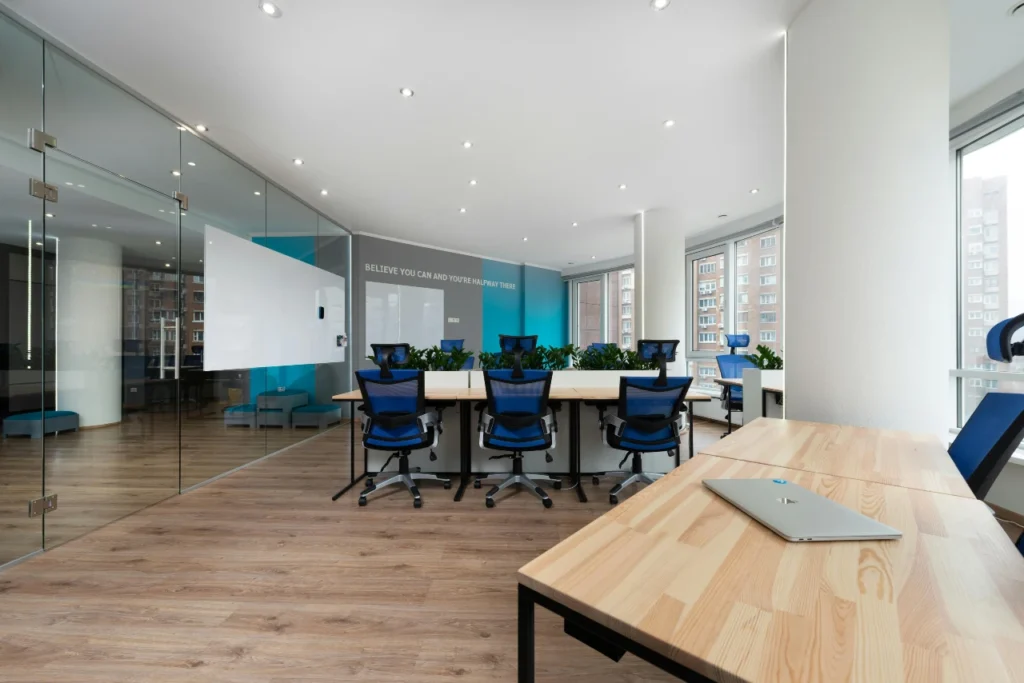
Modern offices are abandoning traditional closed-door layouts in favor of flexible, light-filled spaces that support collaboration while maintaining necessary privacy. Glass partition systems make this balance possible, creating defined work zones without the permanence and expense of traditional drywall construction. At NorTex Glass & Mirror, we’ve been helping businesses across North Texas and Southern Oklahoma design and install office glass partition systems since 2004. This comprehensive guide explains what facility managers, business owners, and architects need to know about glass partition solutions for contemporary workplaces.
The shift toward glass partition systems reflects fundamental changes in how businesses operate. Remote work, hybrid schedules, and collaborative work styles demand flexible spaces that can adapt quickly to changing needs. Traditional drywall construction creates permanent divisions that become obstacles when teams grow, shrink, or reorganize.
Glass partitions solve this challenge. They define spaces while maintaining visual connectivity across the office. Natural light reaches interior areas that would otherwise require artificial lighting all day. Employees can see colleagues and activity throughout the workspace, creating the psychological benefits of an open plan while still providing acoustic separation and defined territories.
According to workplace design research, offices with glass partitions report 20 to 30 percent reductions in lighting costs through daylighting while maintaining the privacy and focus that productivity requires.
Understanding the different partition system types helps businesses match solutions to their specific needs and budgets.
Framed systems feature aluminum or steel frames that provide structural support and design flexibility. These systems accommodate various glass types including clear, frosted, or tinted options. Frame finishes range from standard anodized aluminum to custom powder-coated colors that complement existing office design.
Cost Range: $25 to $45 per square foot installed
Best For:
Framed systems offer the most straightforward installation and the widest range of door options. The frames provide channels for electrical wiring, making them ideal for conference rooms requiring built-in power and data connections. Acoustic performance is excellent because frames create tight seals against floors, ceilings, and walls.
Frameless systems minimize visible framing, creating ultra-modern, minimalist appearances. Glass panels are typically 1/2 inch to 3/4 inch thick tempered or laminated glass, secured with minimal hardware. These systems make bold design statements and maximize transparency throughout offices.
Cost Range: $50 to $75 per square foot installed
Best For:
The challenge with frameless systems is achieving adequate acoustic performance. Without traditional frames creating gasket seals, sound can flank around edges. High-quality frameless installations use specialized sealing systems and may incorporate acoustic laminated glass to compensate.
Demountable (also called relocatable or movable) systems combine permanent installation benefits with future flexibility. These engineered systems allow complete removal and reinstallation without damage to existing structures. As businesses grow or reorganize, entire glass wall assemblies can be relocated to new configurations.
Cost Range: $50 to $75 per square foot installed
Best For:
Demountable systems integrate seamlessly with suspended ceiling systems and can incorporate doors, windows, and electrical components. The higher initial investment pays off when layout changes are needed—relocating demountable walls costs significantly less than demolishing and rebuilding traditional partitions.
Single-glazed partitions use one pane of glass, typically 10mm to 12mm tempered glass. These provide basic visual separation and moderate acoustic performance.
Single-Glazed Acoustic Performance: STC ratings of 30 to 36 depending on glass thickness and sealing quality
Double-glazed partitions feature two panes of glass with an air space between them. This configuration significantly improves acoustic performance while maintaining transparency.
Double-Glazed Acoustic Performance: STC ratings of 40 to 50+ with proper installation and sealing
Double-glazed systems can achieve STC ratings comparable to traditional walls, making them suitable for confidential spaces like executive offices and conference rooms.
The cost difference between single and double-glazed systems ranges from $15 to $30 per square foot additional for double-glazed configurations. For spaces where acoustic privacy is critical, this investment is worthwhile.
Acoustic performance is often the deciding factor in whether glass partitions meet workplace needs. Understanding Sound Transmission Class (STC) ratings helps businesses specify appropriate systems.
According to ASTM International standards, STC measures how much sound (measured in decibels) a partition blocks. Higher STC numbers indicate better sound isolation. STC ratings are determined through standardized laboratory testing.
STC 25-30: Normal speech can be understood through the partition. Suitable only for areas where privacy isn’t a concern.
STC 30-35: Loud speech can be understood, normal speech heard but not clearly understood. Acceptable for breakout spaces and informal collaboration areas.
STC 35-40: Loud speech heard but not understood, normal speech not heard. Good for general office spaces and workstations.
STC 40-45: Loud speech faintly heard, normal speech not heard. Ideal for private offices and meeting rooms.
STC 45-50+: Most sounds not heard. Comparable to solid walls. Required for confidential spaces like HR offices, executive suites, and legal offices.
It’s important to understand that laboratory STC ratings often don’t match field performance. According to acoustic testing research, several factors affect real-world acoustic isolation:
Flanking Transmission: Sound travels through paths other than the glass itself—through ceilings into plenum spaces, under doors, through HVAC ducts, and around partition perimeters.
Installation Quality: Even partitions with STC 50-rated glass can drop into the mid-30s via acoustic flanking through the smallest gaps.
Door Systems: Doors are the weakest acoustic link. Standard sliding doors without proper seals significantly compromise partition performance. Acoustic-rated sliding systems with integrated seal channels and bottom drop seals are necessary to maintain target STC ratings.
Several strategies enhance glass partition acoustics:
Use Dissimilar Glass Thicknesses in Double-Glazed Systems: When both panes are the same thickness, their resonance frequencies match, allowing more sound at those frequencies to pass through. Mixing thicknesses—say 1/4 inch and 3/8 inch—disrupts this resonance effect, improving acoustic performance.
Laminated Glass: A vinyl interlayer between glass layers absorbs mid-range frequencies, boosting STC ratings by 5 to 8 points compared to monolithic glass of the same thickness.
Proper Sealing: Acoustic caulking at all perimeter joints, quality gaskets in frame systems, and drop seals at door bottoms prevent sound flanking.
Full-Height Partitions: Partitions extending to the structural deck above suspended ceilings prevent sound from traveling through plenum spaces.
Visual privacy is equally important in many office applications. Glass partition systems offer multiple solutions for controlling visibility while maintaining natural light benefits.
Frosted glass provides permanent privacy through acid etching or sandblasting. The glass obscures visibility while still transmitting light. Frosting can be applied to entire panels or just at eye level (typically 4 to 6 feet from the floor), balancing privacy with openness.
Custom etching allows incorporation of company logos, patterns, or decorative elements directly into the glass, creating distinctive branding opportunities.
Cost Addition: $8 to $20 per square foot above standard clear glass
Electrochromic smart glass transitions from transparent to opaque at the touch of a button or via automated controls. This technology allows spaces to serve multiple purposes—transparent for natural light when unoccupied, private during confidential meetings.
Smart glass represents the cutting edge of office partition technology, costing approximately $180 per square foot, significantly more than standard glass but delivering unmatched flexibility.
Best Applications:
Tinted glass reduces visibility through color addition—typically bronze, gray, or blue tones. The tint provides partial privacy while maintaining some visual connection. Tinted glass also reduces glare and solar heat gain, improving comfort near windows.
Cost Addition: $5 to $15 per square foot above standard clear glass
Post-installation privacy solutions include adhesive films applied to glass surfaces or integrated blind systems. Films can be clear, frosted, or decorative patterns. Integrated blinds between double-glazed panels provide adjustable privacy without maintenance concerns associated with external blinds.
Strategic design ensures glass partitions meet both functional and aesthetic objectives.
Different office areas require different partition approaches:
Private Offices: Double-glazed systems with STC 40-45, frosted glass at eye level or switchable smart glass. These spaces need strong acoustic performance and visual privacy for confidential work.
Conference Rooms: Double-glazed acoustic systems with STC 40-45+, smart glass or integrated blinds for presentation privacy. Door sealing systems are critical—poorly sealed doors undermine partition acoustic performance.
Breakout and Collaboration Spaces: Single-glazed clear glass with STC 30-35. These informal areas benefit from visual connectivity and don’t require strong acoustic isolation.
Executive Suites: Frameless or minimally framed double-glazed systems, premium finishes, smart glass technology. These high-visibility spaces represent company culture and values.
Workstation Dividers: Single-glazed clear or frosted panels 5 to 6 feet high, framed systems for cost efficiency. These partial-height partitions define territories without creating isolated cubicles.
Successful glass partition installations coordinate with existing building infrastructure:
Ceiling Systems: Partitions must integrate with suspended ceiling grids or extend to structural deck. Coordination affects both acoustic performance and visual appearance.
HVAC: Glass partitions alter airflow patterns. HVAC systems may require rebalancing after installation to maintain comfort in newly defined spaces.
Electrical and Data: Conference rooms and offices need power and data connections. Framed systems with wire channels simplify these installations.
Fire Safety: Fire-rated partitions may be required in certain locations per building codes. Modern fire-rated glass assemblies meet both safety and aesthetic requirements.
Strategic partition placement maximizes natural light benefits. Position glass partitions to allow daylight penetration from windows into interior spaces. According to workplace design research, natural light exposure improves employee health, mood, and productivity.
Consider using clear glass on sides facing windows and frosted glass on sides facing interior circulation, balancing privacy with light distribution.
Understanding the installation process helps businesses plan for minimal disruption.
Site Assessment: Professional glaziers evaluate existing conditions including floor levelness, ceiling type, structural support, and access routes for material delivery.
Design and Engineering: Detailed measurements, structural calculations for glass loads, door hardware specifications, and electrical coordination.
Permitting: Building permits may be required depending on local jurisdiction and scope of work.
Timeline: 2 to 4 weeks
Site Preparation: Protecting existing finishes, establishing work areas, coordinating with other trades.
Base and Track Installation: Mounting floor tracks and ceiling support systems. Proper alignment is critical for smooth door operation and acoustic sealing.
Panel Installation: Setting glass panels, adjusting for perfect vertical alignment, installing gaskets and seals.
Door and Hardware Installation: Hanging doors, adjusting for proper operation, installing locks and closers.
Timeline: Small offices (2-3 partitions) can be completed in 2-3 days. Larger projects may require 1-2 weeks depending on complexity.
Many installations occur outside normal business hours to minimize disruption. Weekend or evening work adds 15 to 25 percent to labor costs but may be worthwhile for businesses that can’t afford operational downtime.
Office glass partition costs vary significantly based on multiple factors. Understanding these variables helps with accurate budgeting.
Straight Runs: Most cost-effective. Simple linear partitions minimize fabrication time and installation complexity.
Corners and Returns: Add complexity and cost. Each corner requires custom fabrication and careful alignment.
Height: Partitions over 10 feet require thicker glass for stability and may need additional structural support.
Door Systems: Doors significantly impact total cost. Basic hinged doors add $1,500 to $3,000 per opening. Sliding doors with acoustic sealing systems cost $3,000 to $6,000 per opening. Frameless glass doors with premium hardware reach $4,000 to $8,000 per opening.
Labor costs vary by location. Major metropolitan areas typically see 15 to 25 percent higher installation costs compared to suburban or rural locations. North Texas and Southern Oklahoma fall in the moderate range for commercial glazing labor rates.
Custom finishes, colored frames, specialty glass treatments, and integrated technology add 5 to 15 percent to base material costs but create distinctive appearances aligned with brand identity.
Glass partitions require minimal maintenance compared to traditional drywall, but regular care ensures optimal appearance and function.
Glass partitions show fingerprints, smudges, and dust more readily than opaque walls. Regular cleaning maintains professional appearance:
Professional commercial cleaning services typically charge $0.50 to $1.50 per square foot for thorough glass partition cleaning. For a typical office with 500 square feet of glass partitions, expect annual cleaning costs of $1,500 to $4,000 for professional service.
Door hardware requires periodic attention:
Neglected hardware fails prematurely and creates security or operational issues.
Acoustic performance depends on seal integrity. Annual inspection identifies gaps or deterioration before acoustic performance degrades. Gasket replacement every 7 to 10 years maintains original performance.
Quality glass partition systems last 20 to 30 years with proper maintenance. The glass itself is highly durable and doesn’t degrade. Frames, hardware, and seals have shorter lifespans but are replaceable without removing the entire partition.
This longevity significantly exceeds traditional drywall (15 to 20 years before renovation), especially considering glass partitions can be relocated or reconfigured rather than demolished.
Glass partitions represent substantial investments, but returns extend across multiple areas.
Natural light reduces artificial lighting requirements by 20 to 30 percent according to energy efficiency research. For a 10,000-square-foot office spending $15,000 annually on lighting, that’s $3,000 to $4,500 in annual savings.
Over a 20-year lifespan, cumulative lighting savings reach $60,000 to $90,000—often covering a significant portion of initial partition investment.
Workplace research consistently demonstrates that natural light exposure improves employee performance. Studies show productivity gains of 5 to 15 percent in naturally lit workspaces compared to artificially lit environments.
For a business with 50 employees earning average salaries of $50,000, even a 5 percent productivity improvement represents $125,000 in additional annual value. These gains dwarf the cost of glass partition systems.
Traditional drywall partitions become sunk costs when businesses reorganize. Demolition and reconstruction for layout changes cost $15 to $35 per square foot. Demountable glass partition systems relocate for $8 to $15 per square foot—less than half the cost of traditional renovation.
For rapidly growing or evolving businesses, this flexibility prevents thousands of dollars in unnecessary construction costs with each reorganization.
Quality glass partition installations increase property values measurably. According to commercial real estate appraisals, well-executed office improvements including glass partitions can add 3 to 7 percent to property values.
For a commercial property valued at $2 million, even a 3 percent increase represents $60,000 in added equity—often exceeding the cost of partition installation.
Quality installation is as important as quality materials. Professional commercial glaziers bring expertise that prevents costly mistakes.
Structural Assessment: Evaluating floor flatness, ceiling types, and structural support capacity for glass loads.
Precise Measurement: Accurate field measurements accounting for building irregularities that can’t be captured in architectural drawings.
Code Compliance: Ensuring installations meet local building codes, fire safety requirements, and accessibility standards.
Quality Materials: Access to commercial-grade materials, hardware, and sealing systems not available to general contractors.
Warranty: Comprehensive warranties on both materials and labor, typically 1 to 3 years on installation workmanship and 5 to 10 years on materials.
When evaluating commercial glazing contractors for office partition projects, consider:
Office Experience: Verify contractors have completed similar office partition projects. Request references from other businesses.
System Expertise: Ensure contractors understand different partition systems, acoustic requirements, and can recommend appropriate solutions for specific applications.
Project Management: Office partition projects require coordination with other trades, minimal disruption to operations, and flexible scheduling. Contractors should demonstrate strong project management capabilities.
Insurance and Licensing: Confirm proper licensing for commercial glazing work and comprehensive insurance coverage.
At NorTex Glass & Mirror, our team has extensive experience with office partition systems throughout North Texas and Southern Oklahoma. We understand the unique requirements of modern workplaces and work closely with facility managers and business owners to deliver solutions that meet functional, aesthetic, and budgetary requirements.
Office partition technology continues evolving, with several trends shaping future workplace design.
Beyond smart glass, partitions increasingly incorporate integrated technology: embedded LED lighting for task illumination or decorative effects, wireless charging stations built into partition systems, and digital display integration for wayfinding or information sharing.
Businesses increasingly prioritize sustainability in building improvements. Glass partition manufacturers are responding with products featuring recycled aluminum frames (up to 75 percent recycled content), low-VOC adhesives and sealants, and demountable systems designed for complete material reuse.
These sustainable features support LEED certification and align with corporate environmental commitments.
Standardized, modular partition components speed installation and reduce costs. These systems use interchangeable parts that can be configured in unlimited ways, providing design flexibility without custom fabrication expenses.
New acoustic interlayer technologies for laminated glass improve sound blocking without increasing thickness. Advanced sealing systems and door designs continue closing the acoustic performance gap between glass partitions and traditional walls.
Glass partition systems represent strategic investments in workplace performance, employee satisfaction, and operational flexibility. The right partition choices create defined spaces that support focused work while maintaining visual connectivity and natural light benefits throughout offices.
While glass partitions require higher initial investment than traditional drywall, the returns—energy savings, productivity gains, space flexibility, and property value appreciation—far exceed costs. Modern offices that prioritize quality glass partitions create better work environments while improving long-term operational efficiency.
At NorTex Glass & Mirror, we’ve been helping North Texas and Southern Oklahoma businesses design and install office glass partition systems for over 20 years. Our team understands the complex interplay of acoustics, privacy, design, and budget that office projects demand.
Ready to discuss glass partition solutions for your office? Contact NorTex Glass at (903) 813-0985 for a consultation. We’ll assess your specific needs, explain appropriate options, and provide detailed proposals with transparent pricing.
Whether you’re renovating existing office space, planning a new facility, or addressing specific acoustic or privacy challenges, we bring the expertise and experience to deliver glass partition solutions that support your business objectives.
Explore our portfolio of completed projects or visit NorTex Glass & Mirror to learn more about our commercial glazing capabilities. For insights on energy-efficient glass performance, read our article on how energy-efficient commercial glass can transform your business.
Industrial facilities and manufacturing plants face a unique challenge: balancing the need for durability and safety with operational efficiency. While …
Modern offices are abandoning traditional closed-door layouts in favor of flexible, light-filled spaces that support collaboration while maintaining necessary privacy. …
Complete guide to healthcare facility glass solutions. HIPAA compliance, fire-rated systems, acoustic control & energy efficiency for hospitals in North Texas & Oklahoma.