

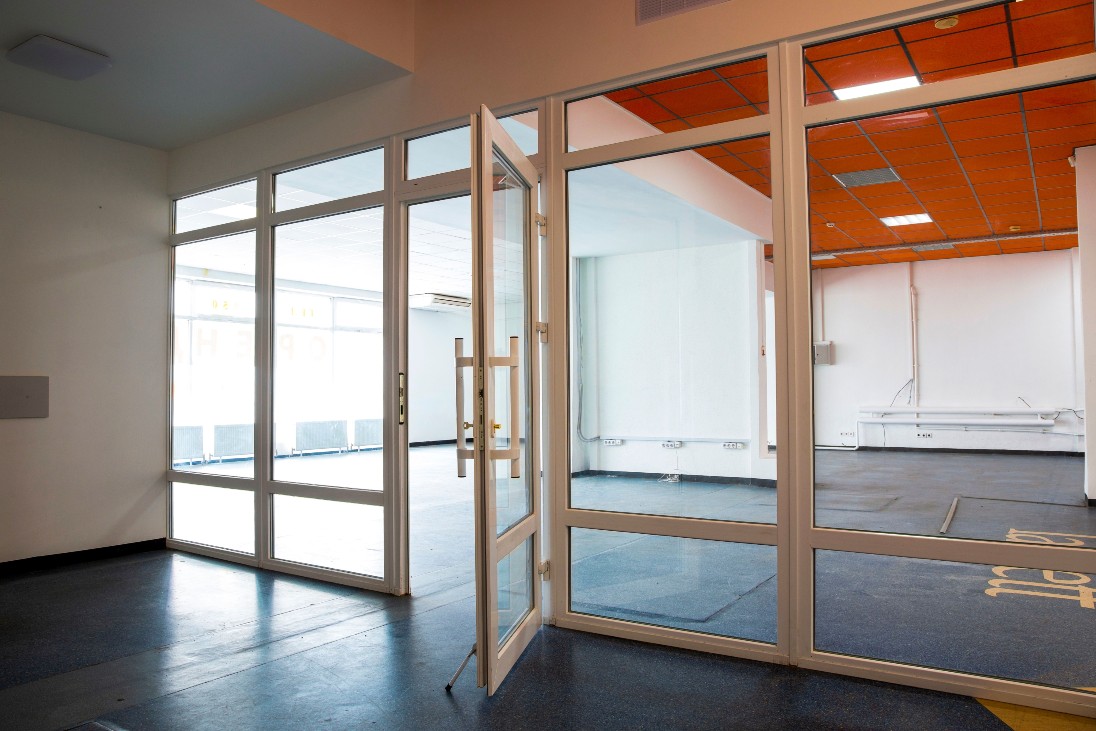
Every commercial building has walls and doors designed to slow a fire down. They separate corridors, stairwells, and exits from the rest of the building so people have time to get out and firefighters have time to get in.
For decades, those areas were built with solid walls and small wired-glass windows. Today, fire-rated glass allows daylight, visibility, and open design in the same locations—without giving up protection.
The terminology can be confusing, though. Ratings, labels, test standards, and code limits all affect which product belongs in which opening. Here’s what building owners, facility managers, and contractors should know about fire-rated glass and where your building needs it.
Fire-rated glass is glazing that has been tested as part of an assembly to remain in place during a fire for a specific period of time. Ratings are expressed in minutes, typically from 20 to 120.
Ordinary glass does not perform this way. Standard annealed and tempered glass can break quickly when exposed to high heat, leaving an open path for flames and smoke.
Fire-rated glazing helps:
One important point: the rating applies to the complete assembly. Glass, framing, gaskets, and hardware are tested together and have to be installed together.
All fire-rated glass falls into one of two categories. Understanding the difference is the key to choosing the right product.
Fire-protective glass blocks flames and smoke. It does not block significant radiant heat.
Common products include specialty tempered glass, ceramic glass, and traditional wired glass. Ratings generally range from 20 to 90 minutes. These products are tested to fire window and fire door standards such as NFPA 257 and NFPA 252.
Fire-protective glass is typically used in:
Because heat can pass through the glass, building codes limit where and how much fire-protective glazing can be used.
Fire-resistive glass blocks flames, smoke, and radiant and conductive heat. Most products use multiple layers of glass with clear interlayers that turn opaque and expand when exposed to fire, forming an insulating barrier.
Fire-resistive glazing is tested to ASTM E119, the same standard used for fire-rated walls. Ratings are typically 60 to 120 minutes.
Because it performs like a wall, fire-resistive glass can be used in much larger areas, including:
It is thicker, heavier, and more expensive than fire-protective glass. It is also the only option when the code calls for a transparent wall rather than a protected opening.
The rating required for an opening depends on the rating of the wall around it. The International Building Code sets these requirements, and local jurisdictions adopt and amend them.
The following are common examples. Always confirm requirements with your design team and local code official.
Typically required for doors in one-hour corridors and smoke barriers. Glass in 20-minute doors is often tested without the hose stream test, so it should not be substituted into openings that need a higher rating.
A common rating for windows, sidelites, and transoms in one-hour corridor walls and fire partitions.
Typically required for doors in stairwells and other exit enclosures. One-hour enclosures generally use 60-minute doors, and two-hour enclosures use 90-minute doors.
Two-hour ratings apply to walls, not just openings. Glazing used as part of a two-hour fire barrier has to be fire-resistive.
In the United States, most ratings above 20 minutes require the hot glass to withstand a blast from a fire hose immediately after the fire test. This confirms the assembly can handle thermal shock and impact. Products that have not passed the hose stream test are limited to 20-minute applications.
Fire-rated glazing shows up in more places than most owners expect.
Exit corridors in schools, healthcare facilities, offices, and multi-family buildings are often one-hour rated. Doors, sidelites, and windows that open onto these corridors need matching protection.
Stairs are the primary way out of a multi-story building, so requirements are stricter. Doors usually need 60- or 90-minute ratings. Where occupants will pass close to the glass on their way out, codes often require glazing that limits heat transfer. Vision panels larger than 100 square inches in these doors generally have to be fire-resistive.
Fire door assemblies include the door, frame, glass, and hardware. Rated doors have to close and latch on their own. Propping them open or changing the hardware can defeat the entire assembly.
Fire-rated systems are especially common in medical projects. Our guide to glass solutions for modern healthcare buildings explains how they fit with privacy, acoustic, and infection-control needs.
A few code provisions cause most of the confusion on fire-rated glazing projects.
In one-hour walls, fire-protective windows are generally limited to 25 percent of the wall area shared with any one room. Fire-resistive glazing tested as a wall is not subject to that limit. If the design calls for a fully glazed corridor wall, fire-resistive glass is usually required.
Fire-rated glass in doors, sidelites, and other hazardous locations also has to meet safety glazing requirements for human impact. A fire rating alone is not enough.
Traditional wired glass was the standard fire-rated product for generations, and many older schools and public buildings still have it. It is not impact-safe. Current codes do not allow traditional wired glass in hazardous locations unless it meets safety glazing standards.
If your building has wired glass in doors or sidelites, replacement with a modern fire- and impact-rated product is worth discussing. This ties closely to the upgrades covered in our school safety glass guide for Texas campuses.
Every piece of fire-rated glass carries a permanent label that inspectors look for. The markings describe what the glass has been tested to do:
For example, a label reading “D-H-90” identifies glass for a 90-minute fire door that passed the hose stream test. A label reading “W-120” identifies fire-resistive glass rated for two hours.
Labels should never be removed, painted over, or hidden by film. Missing labels are a common reason for failed inspections.
Fire-rated glass only performs when it is installed in a compatible rated frame with the correct glazing materials.
Keep these points in mind:
Modern fire-rated framing is available in narrow steel and aluminum profiles that blend with surrounding storefront and glass partition systems. Rated openings no longer have to look institutional.
Include fire-rated doors and windows in your regular building inspections. Our commercial glass maintenance checklist covers what to look for in doors, hardware, and seals.
Fire-rated glazing is a specialty product with longer lead times and higher costs than standard glass. Early planning helps control both.
On renovations, verify the rating of existing walls before replacing any glass. Swapping rated glass for standard glass, even by accident, creates a code violation and a real safety risk.
Fire-rated glazing protects people first and property second. It has to be specified correctly, installed exactly as tested, and documented for inspection.
NorTex Glass is a fully bonded commercial glass and glazing contractor serving North Texas and Southern Oklahoma. We work on healthcare, educational, multi-family, office, municipal, and judicial facilities where fire-rated openings are part of everyday construction.
Browse our commercial glass portfolio or contact NorTex Glass to discuss fire-rated glass for your next project.
Fire-protective glass blocks flames and smoke for 20 to 90 minutes but allows radiant heat to pass through. Fire-resistive glass blocks flames, smoke, and heat, and is tested to the same standard as a rated wall. Fire-resistive products are required for larger glazed areas and higher-rated walls.
No. Standard tempered glass is a safety glazing product, not a fire-rated one. It can break quickly under fire conditions. Only glass that has been tested, listed, and labeled for fire performance can be used in a rated opening.
Traditional wired glass does not meet impact safety requirements and is no longer allowed in doors, sidelites, and other hazardous locations under current codes. Newer wired products with safety film or lamination are available, but most projects now use clear ceramic or fire-resistive glass instead.
Look for a permanent label etched or printed in a corner of the glass. It should show the manufacturer, the listing agency, and markings such as D, H, T, OH, or W followed by a number of minutes. If there is no label, assume the glass is not rated and have it evaluated.
Not anymore. Modern fire-rated products are clear, wire-free, and available in large sizes. Combined with narrow-profile rated framing, they can closely match the look of surrounding non-rated glazing systems.
Every commercial building has walls and doors designed to slow a fire down. They separate corridors, stairwells, and exits from …
Planning a stadium, field house, or athletic facility? Learn how to choose safe, durable sports complex glazing, from press box windows to game-day entrances.
Ensure your commercial glass stays in top condition with our maintenance checklist. Discover inspection tips and professional services from Nort Glass in Sherman, TX.